Hog Killing on the Farm

Not for the squeamish …. 
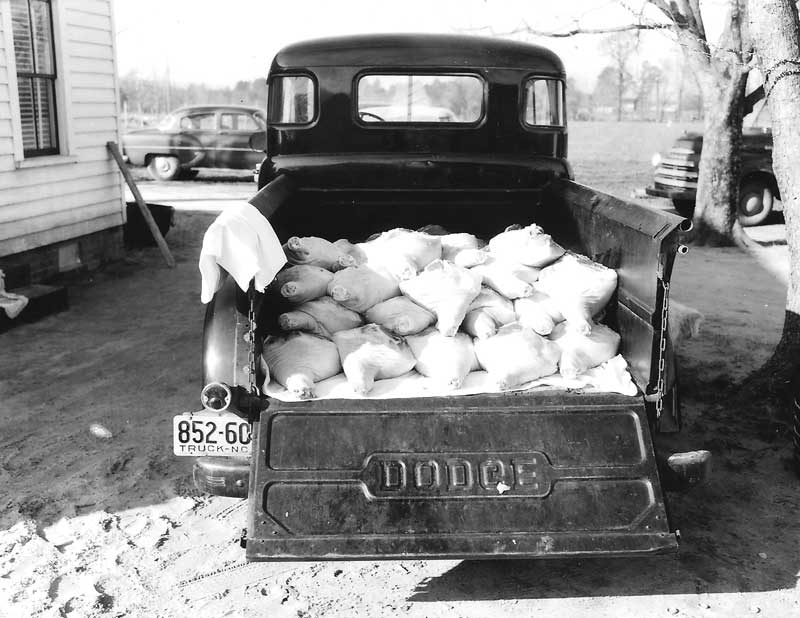
Old Dodge truck with hams at Big Mill B&B near Greenville, North Carolina

(Truthfully, if you want to remember all farms as Green Acres, maybe skip this post)

It seems my meat-eating city friends seem to think sausages commit suicide or that hogs retire to Florida before becoming bacon. So be forewarned  - this is what really happens just before the bacon becomes bacon.

Some years ago, cold weather on the farm here in eastern North Carolina meant hog killing time and that happened at first light on a cold, cold morning usually in January or February.  
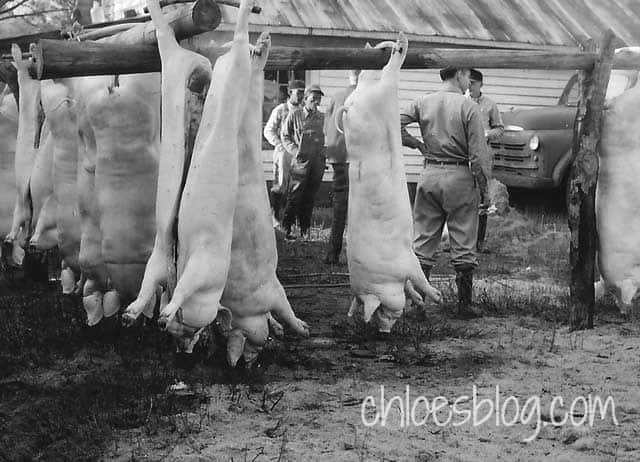
Martin County NC hog killing

(Brother John backside with boots-a hammock hangs here today.
The big old truck in this photo is still running)

The hogs were about nine months old and weighed about 200 pounds.  No boar hogs were slaughtered – only females and castrated males; this part they didn't explain to me. My dad, Ops, couldn't kill his own hogs. 

My brother John told me that sometimes they fed coal to the hogs – he said it made their intestines smooth. Hmmm. I remember that they poured burnt cylinder oil on the hogs.  I guess that was for dry skin.

Neighbors helped neighbors. Each week my folks would get up really early and go and help other farmers kill hogs. They, in turn, came and helped us.
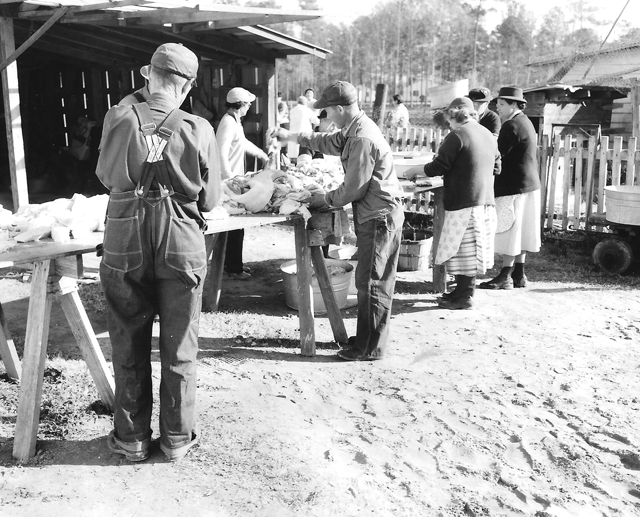
Hog meat being cut up and processed at Big Mill Bed and Breakfast in Williamston, NC

(That's my mother, Chloe, in the middle with the hat)

As a child, it was alright for me to go in the pasture with the mules and cows, but not with the hogs. But the best fishing worms were in the hog pens. I did sneak in to get those Rocky Mountain crawlers. Don't tell anybody.

When it was our turn to have the hog killing, I was very excited. I could stay home from school. The food was phenomenal: fried chicken, country ham, sausage, collards, succotash, sweet potatoes, corn bread, biscuits and so many desserts.
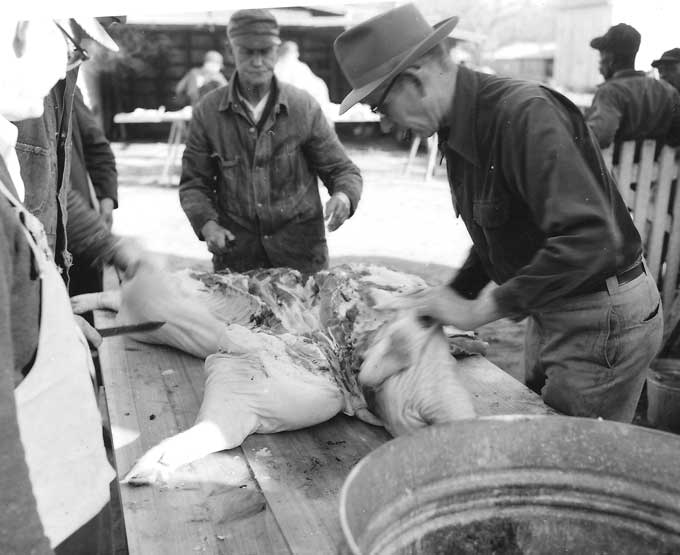
Johnny Gurkin on the farm in Williamston North Carolina

(My dad, Johnnie Gurkin, is on the right foreground in the photo above. Uncle Jimmy is at the end of the table and Henry Peel is leaning on the picket fence)

My dad couldn't kill his own hogs – someone else had to do that job. We killed 20 hogs each winter.
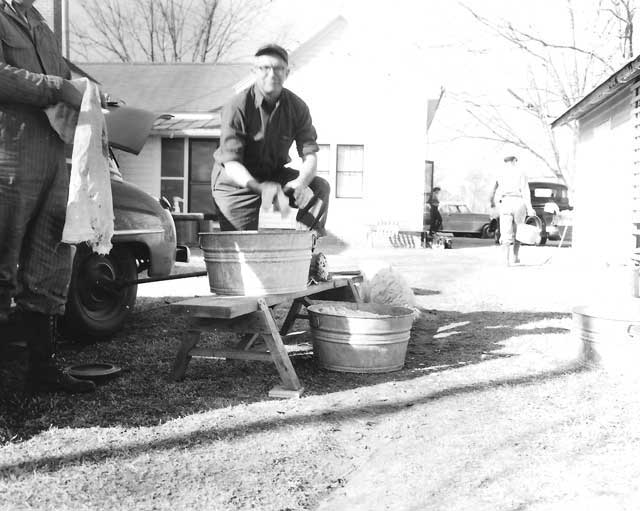
Sausage making at Big Mill in 1950

(Stuffing sausage. Brother John is walking away on the right.
That is also my back door here at Big Mill Bed and Breakfast.
That well-bench is still there, only now it has pansies growning on it.)

Uncle Charlie was the sausage man-he seasoned all the sausage. Aunt Annie had a sage bed and grew sage for everyone. Ops liked sausage to be HOT so lots of red pepper flakes were added to our sausage  The ground up pork, fat and seasonings were stuffed into casings of small intestines (chitterlings) and hung in the smoke house to dry. Fresh sausage was called green, as opposed to dry.
Photos of Big Mill B&B back in the days before it was a North Carolina bed and breakfast.

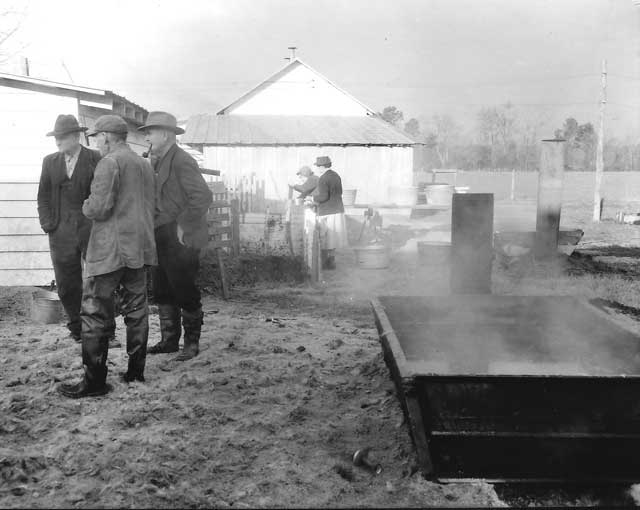
Just beyond this scalding vat is the hole where the chitterlings were cleaned. It is now my glorious organic garden. It grows tall sunflowers and lots of wonderful fruit and vegetables that we serve to our guests here at Big Mill Bed & Breakfast.  

Hogs were killed, bled, scalded (to remove bristles), cut up, salted, cooked or cured. Five families lived here so we needed the food. The smoke house and all the buildings in these photos are still here. So are the lard paddles and scrapers and the large crocks that were used to store the salt pork.

Same farm, same family, same trees, same outbuildings, same house. Heritage is a precious thing.

These wonderful black & white photos were taken almost
60 years ago by my brother-in-law Barney Conway, Sr
.

12 Comments »

12 Responses to “Hog Killing on the Farm”

  1. Jody on 12 Mar 2010 at 10:01 am #

    Chloe — What a fascinating  read!  Your blog is a journey through time and I always feel like I'm right there with you through the years.  You defy Thomas Wolfe — Yes you CAN go home again.  I'm certain I've never read a bed and breakfast blog post anything like this gem.  They broke the mold with you, my friend. And, I must admit — I am relieved the pics are black and whites. 
    Bon appetite!     ;-)

  2. Alisa on 22 Mar 2010 at 3:13 pm #

    That is amazing! 

  3. kathleen on 27 Mar 2010 at 3:20 pm #

    Chloe – I have just reviewed this post again and have many, many questions that can best be answered only in person!  Next week when I return to Big Mill I will bring my inquiries.  Years back in the winter of 1972, I participated in a "hog killing" in Eastern Kentucky, on a farm called "Lend-A-Hand."  I am now looking for the pictures to prove it.  We hung the animal from a backhoe's elevated bucket.  See you next weekend for Easter!  Shall I bring a ham? :)  Kathy

  4. Chloe on 27 Mar 2010 at 8:45 pm #

    Kathy, you just might be a farm girl after all! Chloe

  5. Chloe on 27 Mar 2010 at 8:46 pm #

    thanks, Jody!!! yes, I too am relieved that the photos are in black and white. Chloe

  6. Jo Ann on 17 Nov 2010 at 4:45 pm #

    Chloe- love these pictures! That is exactly like the hog killings I remember at the Pritchard farm in Bertie County when I was a young "farm "girl!!  Nothing better than that fresh fried pork tenderloin and fresh sausage! Enjoy reading your blogs.
    Jo Ann

  7. Chloe on 21 Nov 2010 at 1:08 pm #

    Hi, Jo Ann, so glad to here that other folks had fun at these hog killings. Guess we might write a different comment if we had been the “grown-ups” :)

  8. marian stafford on 10 Dec 2010 at 6:18 pm #

    During the second world war our parents decided to move to the country from the city(Louisville, Ky.) They moved to an area of mostly farmers of German ancestry,.some recent.  They were hard working folks and many had farms and raise much of their food. Hog killing time was a celebration and my grandmother told me I could go help after the hogs were killed.  I was excited as my family were urbanites only moving to the "country" because they thought it would be safer from possible enemy attacks.  So I went to help the neighbors.  They gave me a huge white apron(spotlessly clean) and a chair,turned backward at the sink..I was excited, not knowing what my job would be.  Soon they dumped a huge pile of hogs' intestines in the sink !  I was to clean them and rinse them really well to have them ready for the sausage!  I felt important, but it was probably a job that some one else didn't want to do. The worse thing about the job  was  the water in their house was sulphur water!!!  After gagging at first I managed to finish my  job,  I was about ten years old.  Good memories!  Marian

  9. Chloe on 11 Dec 2010 at 12:29 am #

    oh, My Marian, you were in fact “slinging chitterlings. ” My garden is now over the exact spot of the Chitterlings pit. I was lucky in that I only had to play and eat at the hog killing. Thanks for your insights.

  10. jamie berryhill on 20 Dec 2010 at 9:34 am #

    im lookn for a scalding vat i just started killing hogs and i enjoy it i really need one bad if you have any idea wher one is feel free to call 1-423-613-4312  or 1-423-721-5625 thank

  11. Chloe on 21 Dec 2010 at 9:17 am #

    We still have our scalding vat and it is HEAVY. My brother is using it to mix cement so it is now even heavier. I am sure some of the other farmers still have vats. Will keep my ears open for you. How far will it have to be shipped?

  12. jim kerr on 06 Dec 2011 at 10:22 pm #

    I just view your post, boy, did it bring back memories. The last time my dad killed hogs was in 1955. I stayed home just to watch. The last time I helped kill hogs was at my fil. with my 12 year old son. the killing started at 7am and by 11,  7 hogs was blocked out and in the smoke house. Over the next few days the sausage was made . my fil was the butcher for the local store so he knew his business..  By the time one hog came out of the scalding box and dehaired another hog as ready to go in.

Trackback URI | Comments RSS

Leave a Comment